Short-form campaigns are cheap to produce and easy to launch without a plan, which is why so many produce a burst of views and nothing else. Proper tiktok campaign planning settles the objective and the measure before anyone opens a camera.
Objective before format
Decide what the campaign is for in one sentence: introducing something, re-engaging an audience, supporting a launch happening elsewhere, or answering a question customers keep asking. Each implies a different message and a different measure of success.
Short video attracts a broad audience quickly, much of which has no relationship with the brand. That is fine for awareness and misleading if the campaign was meant to drive a specific action, so agree which one it is at the start rather than reinterpreting the numbers afterwards.
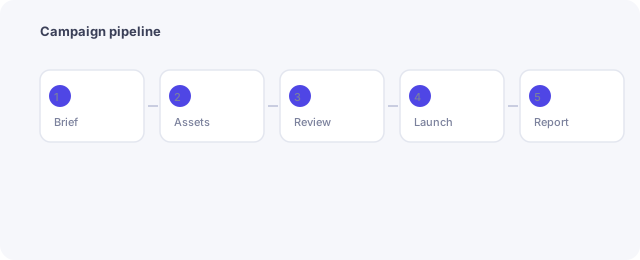
The planning sequence
- Objective: one sentence, one primary outcome.
- Audience: described by behaviour rather than demographics.
- Message: the single idea every video must carry.
- Deliverables: exact counts, with owners and dates.
- Claims boundary: what may not be said, agreed in writing.
- Review gates: who approves, and by when.
- Measurement: what is recorded, against which baseline.
- Wind-down: what happens to the assets and the audience afterwards.
Record the baseline
Write down the previous four weeks before launching. Without it, any post-campaign figure can be presented as a success, and usually is. A baseline turns reporting from persuasion into observation.
Commit to shipping the deliverables and recording the outcome, not to a specific result. Reach on short video varies enormously for reasons no plan controls, and a stakeholder promised a number will remember the number. Scheduling sits in the posting schedule planner, and measurement in the analytics reporting guide.
Common questions
How long should a campaign run?
Long enough to publish the planned videos at a normal cadence. Extending to fill time dilutes the message.
Can several campaigns run at once?
On one account, rarely well. The audience sees one feed, and two messages competing usually means neither lands.
Should paid promotion be part of the plan?
Decide before launch, since it changes who sees the content and therefore how the numbers should be read.
What if early videos underperform?
Continue the plan unless something is factually wrong. Short-form results vary widely between videos in the same campaign.
Who signs off the brief?
Whoever is accountable for the outcome, not the person producing the videos. See contact.
How many videos does a campaign need?
Enough for the message to be seen more than once, which usually means several rather than one. Short-form reach per video varies so much that a single video is close to a coin toss.
Should the campaign have its own hashtag?
Only if you will use it consistently and it is genuinely distinctive. An abandoned campaign tag is a small, permanent piece of clutter.
Related guides
More on this topic from the same section: