Community work is invisible when done well and very visible when it stops. A written community management workflow makes it repeatable rather than dependent on one attentive person who happens to care.
Triage before responding
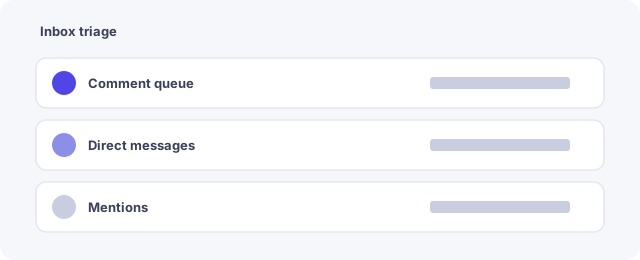
Answering in arrival order means trivia is handled while important questions wait. Sort first — genuine questions, feedback, complaints, spam, and anything needing another team — and handle each type according to its value rather than its position in the queue.
Questions come first. They represent someone actively trying to do something, and answering them promptly is the highest-return activity available in the inbox.
The workflow
- Fixed checking windows rather than continuous monitoring.
- Triage into five categories, consistently.
- Response-time targets per category, published internally.
- Escalation routes for payments, accounts, safety and legal issues.
- Short standard answers for recurring questions, adapted rather than pasted.
- Tone boundaries agreed in writing.
- Recurring questions logged and passed to content planning.
- Rotation and cover, so the work survives holidays.
Standard answers save real time provided they are adapted. Pasted verbatim they are recognisable immediately and make people feel processed rather than helped.
Consistency beats speed
A reliable same-day reply builds more confidence than an occasional instant one followed by three days of silence. Predictability is what makes people willing to ask in the first place, and continuous monitoring is the fastest route to an exhausted responder.
Feed what you learn back into content. The questions arriving repeatedly are briefs written by your audience, and answering them publicly reduces the inbox volume as well as improving the content. Platform specifics sit in the moderation checklist, and escalation in the crisis response plan.
Common questions
Should every message get a reply?
Every genuine question should. Replying to every reaction consumes time that questions deserve.
Who should do community work?
Someone with context and authority to answer. An inbox staffed by people who can only collect questions frustrates everyone.
How many checking windows per day?
Two or three suits most teams. Continuous monitoring costs more attention than it returns.
Should responses be templated?
Start from a template, adapt every time. The saving is in not rewriting facts, not in avoiding writing.
What should be escalated immediately?
Anything about money, account access, safety or legal matters. Front-line staff should never improvise on those. See the services page.
How should out-of-hours messages be handled?
Set expectations rather than pretending to be always available. A stated response window is more reassuring than an unanswered message at midnight.
Should community work be measured?
Track response time and volume by category. Both describe the service being delivered, and both sit within the control of the team.
What should never be answered publicly?
Anything containing another person's details, and anything about an individual account. Move those to a private channel immediately.
Related guides
More on this topic from the same section: