Moderation applied differently on each platform is moderation nobody can defend. One social media moderation checklist, applied everywhere, makes decisions consistent and takes the burden of judgement off whoever happens to be on duty.
Write the boundaries once
The categories are the same wherever you operate: spam, abuse, misinformation about your business, off-topic promotion, and legitimate criticism. Deciding how each is handled once, in writing, removes almost all the case-by-case debate.
Legitimate criticism deserves explicit protection in the policy. It is the category most often removed by mistake, usually by someone acting quickly, and it is the removal most likely to become a larger problem than the original comment.
The checklist
- Written boundaries covering each category, visible to the team.
- Triage: question, feedback, complaint, abuse, spam.
- Response-time targets per category.
- Escalation routes for payment, account, safety and legal matters.
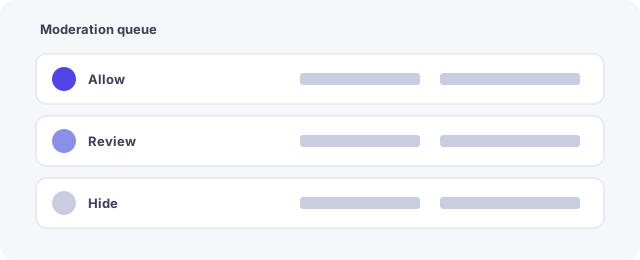
- Who may hide, remove or block, and on what grounds.
- Fixed checking windows rather than continuous monitoring.
- Rotation, so no one person carries it permanently.
- A log of contested decisions.
Protect the moderator
Moderation exposes one person to the worst of the inbox, and doing it continuously is genuinely damaging. Rotate the duty, state plainly that abusive material may be removed without discussion, and do not require anyone to justify each removal individually.
Give moderators authority to act within the policy without checking every case upward. A queue that requires approval for each decision simply does not get cleared, and the backlog itself becomes the problem. Platform detail sits in the Facebook moderation workflow and the TikTok community management guide.
Common questions
Should the policy be public?
A short version, yes. Visible standards are easier to enforce and much easier to defend.
Is hiding better than deleting?
Often. Hiding reduces visibility without the confrontation that deletion frequently provokes.
How fast should complaints be answered?
Same day where possible. Speed matters more than perfect wording.
What about coordinated attacks?
Apply the policy, stop engaging individually, and escalate. Arguing at volume never ends well.
Should moderation decisions be logged?
Log the contested ones. It makes a later dispute far easier to settle. See about.
Should the same policy cover every platform?
The boundaries should. Only the mechanics differ, such as what hiding means or what blocking does, and those are details rather than separate policies.
Who decides borderline cases?
A named person, not a group discussion. Borderline cases arrive constantly, and routing each one to a committee guarantees a backlog.
How often should the policy be revised?
Once a year, plus whenever a case arrives that the policy did not anticipate. Those gaps are the ones worth closing.
Should moderators explain removals?
A brief private note where the person acted in good faith. Silent removals feel arbitrary and generate more argument than they prevent.
Related guides
More on this topic from the same section: