Running a campaign across several vertical surfaces multiplies the coordination without multiplying the budget. Sound short form campaign planning fixes one message centrally and allows only the execution to differ.
One message, adapted
Every video in the campaign should carry the same single idea. Where teams let each platform develop its own angle, the campaign stops being a campaign and becomes three unrelated content pushes that happen to share a date.
Adaptation is legitimate and should be bounded. Pacing, references and caption style can differ; the claim, the offer and the call to action should not. Write that boundary down, because it is the thing that erodes first under production pressure.
Planning the campaign
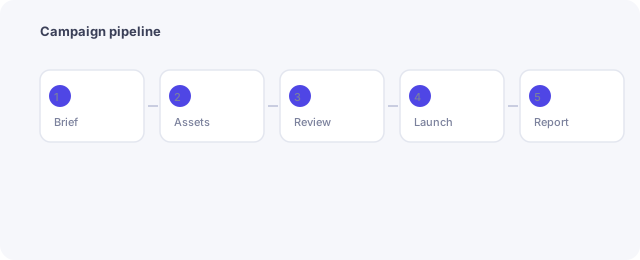
- Objective and primary outcome, in one sentence.
- The single message every video carries.
- Deliverables per platform, with counts and owners.
- What may be adapted, and what may not.
- Claims boundary agreed before production.
- Baseline metrics recorded for each surface separately.
- Review gate before anything is scheduled.
- Wind-down: what is removed or updated when it ends.
Record baselines per platform rather than combined. The surfaces behave differently enough that a blended figure obscures which one actually responded.
Expect uneven results
The same video frequently performs very differently across surfaces, and the reasons are usually outside your control. Treat that as normal rather than as evidence that one platform was executed badly, and avoid rewriting the plan mid-campaign on the strength of a few days of data.
Commit to shipping the deliverables and reporting honestly, not to a reach figure. Short-form variance is large enough that promising a number is effectively promising a coin toss. Production sits in the short form video content workflow, and measurement in performance tracking.
Common questions
Should campaigns launch everywhere at once?
Usually yes, so the message is coherent. Staggering can work where one surface is clearly the priority.
How many videos per platform?
Enough for the message to be seen more than once. A single video is too dependent on chance.
Should paid promotion be included?
Decide before launch, since it changes who sees the content and how the organic numbers should be read.
What if one platform clearly fails?
Finish the campaign and record it. Pulling one surface midway makes the comparison meaningless.
Who owns a cross-platform campaign?
One person, even where different people publish. Shared ownership across surfaces reliably produces drift. See contact.
How long should a short-form campaign run?
Two to four weeks for most. Shorter gives the message too little exposure; longer competes with your ordinary content for the same capacity.
Should the campaign reuse existing footage?
Where it genuinely fits. Retrofitting old clips to a new message usually shows, and viewers notice the mismatch before they notice the campaign.
Related guides
More on this topic from the same section: