Watching competitors is easy; learning something is not. Useful youtube competitor channel analysis limits itself to what can actually be seen, records it consistently, and ends in a decision about your own output rather than a folder of screenshots.
Separate observation from inference
You can see formats, publishing cadence, titles, thumbnails, playlist structure and public view counts. You cannot see their retention, their revenue, their production cost or whether any of it is working for them commercially. Treating a high view count as proof of a good strategy is how teams copy approaches that are quietly failing.
Choose three or four channels and observe them over time rather than surveying twenty once. Change is the informative part — a channel that has shifted format recently is telling you something a snapshot cannot.
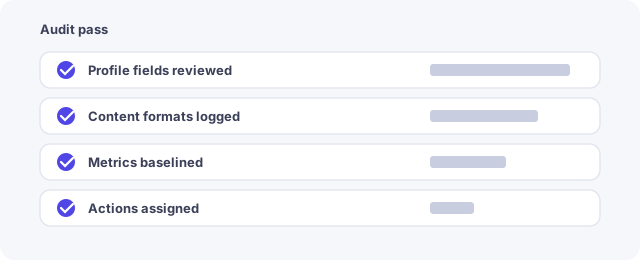
What to record
- Publishing cadence and typical video length.
- Format mix, including how much is short-form.
- Title and thumbnail patterns, described rather than collected.
- How the channel page introduces itself to a newcomer.
- Subjects that recur, and subjects conspicuously absent.
- Questions in their comments that go unanswered.
The unanswered comments are the most valuable row. They point at demand the competitor is not serving, which is a far better basis for a video than replicating what they already cover well.
End with choices
Close every analysis with three short lists: adopt, deliberately differ, ignore. The middle list is the one that matters — a channel that mirrors its competitors gives viewers no reason to pick it over the one they already watch.
Be cautious about matching production values you cannot sustain. Copying an expensive format with fewer resources usually produces a weaker version of someone else's idea, where a cheaper format executed properly would have been stronger. Feed conclusions into content series planning and check your own position first with the channel audit checklist.
Common questions
How often should this run?
Twice a year. Watching competitors continuously produces reactive content and a follower's posture.
Are estimate tools worth using?
For rough ordering only. Their figures are modelled, and confident decisions built on modelled data go wrong quietly.
Should the whole team see the research?
Share the decisions rather than the raw material, which tends to get imitated without the reasoning attached.
What if a competitor is far larger?
Study their early videos rather than their current ones. Those were made with resources closer to yours. See the services page.
Should you watch competitors as a viewer?
Yes, occasionally, all the way through. Studying a channel only through its analytics-shaped surface misses why people actually stay with it.
Is it worth tracking channels outside your subject?
Often more than direct rivals. Formats travel between subjects well, and borrowing a structure is far safer than borrowing a position.
Related guides
More on this topic from the same section: