Agencies rarely fail on creative ability. They fail on repeatability — the third client arrives and the process that worked for two stops holding. A written social media agency workflow is what makes the fourth client an addition rather than a crisis.
One process, many clients
The temptation is to shape the work around each client's preferences. That produces a different process per account, which cannot be staffed, covered during holidays, or handed over when someone leaves.
Keep one process and allow variation only where it genuinely matters: approval depth, reporting format, and cadence. Everything else — how work is briefed, drafted, reviewed and scheduled — should look identical whichever account it belongs to.
The stages
- Intake: what the client wants, what they have, what they can approve.
- Plan: themes, cadence and deliverables agreed for the period.
- Brief: each item written before anyone produces anything.
- Produce: to a documented standard, not to individual taste.
- Review: internal accuracy and claims check before the client sees it.
- Client approval: scoped and time-boxed.
- Schedule and publish, with response cover arranged.
- Report: same structure every period.
The internal review before client approval is the stage most often dropped under pressure, and the one that protects the relationship most. Clients should never be the first people to notice an error.
Capacity is the real constraint
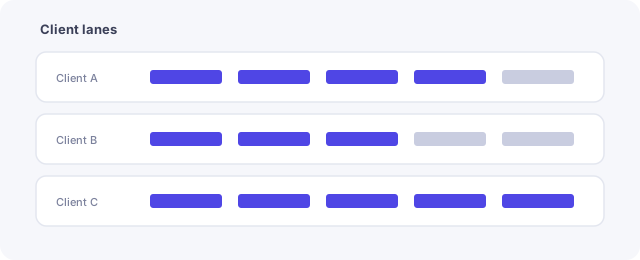
Most agency problems present as quality problems and are actually capacity problems. When a team is carrying more accounts than it can brief properly, the briefs thin out first, then the reviews, then the reporting.
Track deliverables promised against deliverables shipped per account. A persistent gap is a signal to renegotiate scope rather than to ask the team to try harder, and it is far easier to raise early than after three months of quiet shortfalls. Intake detail sits in the client onboarding workflow, and reporting in the campaign reporting workflow.
Common questions
How many accounts can one person hold?
It depends on cadence and approval depth. Measure it from your own delivery record rather than adopting a general figure.
Should clients see the internal process?
The stages and timings, yes. It sets expectations about when their input is needed.
What if a client wants a different process?
Accommodate approval and reporting preferences. Rebuilding production for one account rarely pays for itself.
Who owns the process document?
One named person with authority to change it when a step proves useless.
How often should it be reviewed?
Twice a year, and after losing or winning a large account, since both change the shape of the work. See the services page.
Where should the process live?
Where the work happens rather than in a separate system. A process document nobody opens is functionally identical to having no process at all.
Related guides
More on this topic from the same section: