Moderation decisions made case by case are inconsistent by construction. A written facebook community moderation workflow settles the rules in advance so the person on duty applies a policy rather than a mood.
Write the rules before you need them
Decide what is removed, what is hidden, what is answered and what is left alone. Publish the rules where the community can see them, since visible standards are easier to enforce and much easier to defend when someone objects.
Distinguish disagreement from abuse. Criticism of the business is legitimate and removing it reliably makes things worse; personal attacks, spam and harassment are different and should be handled without debate.
The workflow
- Written rules, visible to the community.
- Triage into questions, feedback, complaints, abuse and spam.
- Answer questions first; they carry the clearest value.
- Escalate anything about payments, accounts, safety or legal matters.
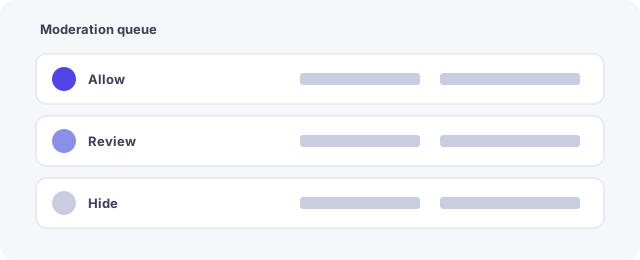
- Apply hiding and removal per the rules, not per case.
- Check in fixed windows rather than continuously.
- Rotate the duty so nobody absorbs it indefinitely.
- Log recurring complaints; they usually point at a real problem.
Handle criticism in the open
A brief public reply followed by a private message handles most complaints well. It shows other readers that the business responds, without conducting the whole exchange in front of an audience.
Never delete reasonable criticism. It escalates predictably, and the removal usually becomes a larger story than the original complaint. Log recurring complaints and pass them to whoever can fix the underlying issue, since moderation cannot solve a genuine product problem. Related practice sits in the moderation checklist and the crisis response plan.
Common questions
Should comments ever be turned off?
Only briefly and for a stated reason. As a default it reads as avoidance and removes useful signal.
Who should moderate?
Someone with context and authority to answer, rotated so the duty does not fall on one person permanently.
How quickly should complaints be answered?
Same day where possible. Speed matters more than a perfectly worded reply.
What about repeated bad-faith commenters?
Apply the written rules consistently, including blocking where warranted. Consistency is what makes it defensible.
Should moderation actions be logged?
Briefly, for anything contested. It makes a later dispute much easier to resolve. See about.
Should rules be enforced on regulars?
Especially on regulars. Selective enforcement is noticed quickly and undermines every subsequent decision the moderators make.
What about comments in other languages?
Translate before acting. Removing something you did not understand is how legitimate feedback gets deleted and the complaint gets louder.
How much moderation is too much?
If members start asking whether they are allowed to post, the rules are either too broad or applied too aggressively, and discussion will thin out quickly.
Related guides
More on this topic from the same section: