Accounts without themes publish whatever occurred to someone that week. A clear instagram content pillar set fixes that by naming three or four recurring subjects the account genuinely commits to, so planning starts from a choice rather than a blank page.
Pillars come from the audience, not the org chart
The common mistake is deriving pillars from internal structure — one per department, or one per product line. Audiences do not care how the business is organised. Pillars should map to what people are trying to do, which usually cuts across internal boundaries.
Three or four is the workable range. Two is restrictive and produces repetition; six or more stops being a structure at all, because everything fits somewhere and the framework no longer rules anything out.
Defining a pillar properly
- A short name the whole team uses consistently.
- The audience need it serves, in one sentence.
- Two or three example posts that clearly belong.
- One example that does not belong, and why.
- Its rough share of the month's output.
- Which formats suit it best.
The counter-example is the most useful line. A pillar that excludes nothing is a label rather than a decision, and labels do not help anyone choose what to make next.
Balance drifts, so check it
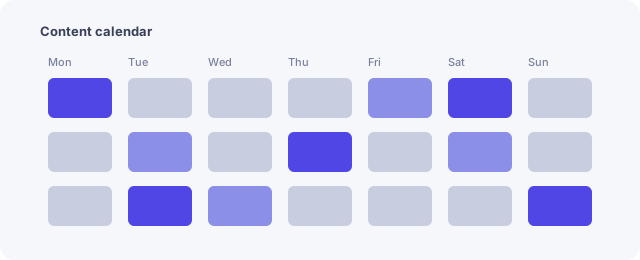
Teams gravitate to the pillar that is easiest to produce. Over a few months an account intended to cover four subjects becomes an account about one, usually without anyone deciding that. Comparing planned share against published share each month makes the drift visible while it is still easy to correct.
Review the pillars themselves twice a year. They should change when the audience or the business changes — but deliberately, as a decision, rather than eroding one convenient week at a time. The research that informs them is in the audience research workflow; scheduling is in the content calendar workflow.
Common questions
Must every post belong to a pillar?
Most should. Leave room for timely posts that fit none — but if that category grows, the pillars are wrong.
Should pillars be shared publicly?
No need. They are an internal planning tool, and audiences experience the result rather than the framework.
How do pillars relate to formats?
Loosely. A pillar is a subject and a format is a delivery method, so most pillars can run across several formats. Locking one pillar to one format usually reflects habit rather than a decision.
What if one pillar clearly outperforms?
Increase its share, but do not eliminate the others without thought — a single-subject account narrows who will follow it. See the FAQ. Strong performance in one pillar can also reflect where the effort went, rather than where the interest is.
Related guides
More on this topic from the same section: