Most competitor research produces a folder of screenshots and no decisions. Disciplined instagram competitor analysis restricts itself to what is publicly observable, records it in a fixed structure, and ends with a choice about your own account.
Observe what is actually visible
You can see what someone published, how often, in what formats, how they describe themselves, and roughly how their audience responds. You cannot see their strategy, budget, results, or whether any of it is working commercially. Confusing the second list for the first is how teams end up copying tactics that are quietly failing for their originator.
Pick three or four accounts, not fifteen. A small set observed properly over time beats a large set observed once, and the value comes from noticing change rather than cataloguing a moment.
What to record
- Posting frequency and format mix over a fixed recent window.
- How the profile describes who it is for.
- Recurring content themes, and which recur most.
- Visibly strong posts, with a note on what distinguished them.
- How they handle comments and questions.
- Gaps: subjects their audience raises that they do not address.
That last row is the one that generates opportunities. Everything above it describes the competitor; the gaps describe an opening for you.
From observation to decision
End every analysis with a short list of choices: what to adopt, what to deliberately do differently, and what to ignore. "Do differently" deserves as much attention as "adopt" — an account that mirrors its competitors gives an audience no reason to choose it.
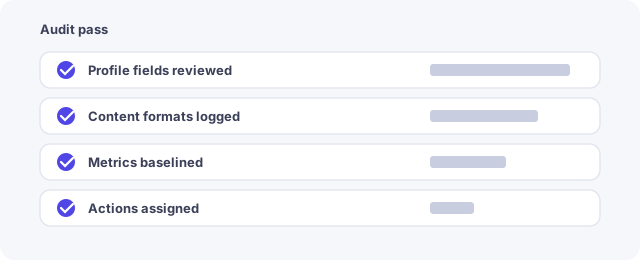
Be wary of copying format ratios. A competitor posting mostly video may be doing so because of team skills you do not have, and matching their mix with weaker execution produces worse results than playing to your own strengths. Use the profile audit checklist on your own account first, so comparisons are grounded in your actual position, then feed conclusions into content pillar planning.
Common questions
How often should this run?
Twice a year is plenty for most accounts. Monitoring competitors weekly tends to produce reactive content and a follower's posture.
Are third-party estimate tools reliable?
Treat their figures as rough indicators. Estimated data presented as fact leads to confident decisions built on numbers nobody can verify.
Should findings be shared with the wider team?
Share the decisions, not the raw file. Raw competitor material circulating widely tends to get imitated without the surrounding reasoning. See contact.
Should we track competitors we do not compete with?
Occasionally, yes. Accounts outside your category often solve presentation problems in ways your direct competitors have not tried, and borrowing a format is far safer than borrowing positioning.
What if a competitor grows quickly?
Note it, then check what is publicly verifiable before reacting. Rapid visible growth has many causes, and rebuilding your plan around an unexplained curve is how teams abandon something that was working.
Related guides
More on this topic from the same section: