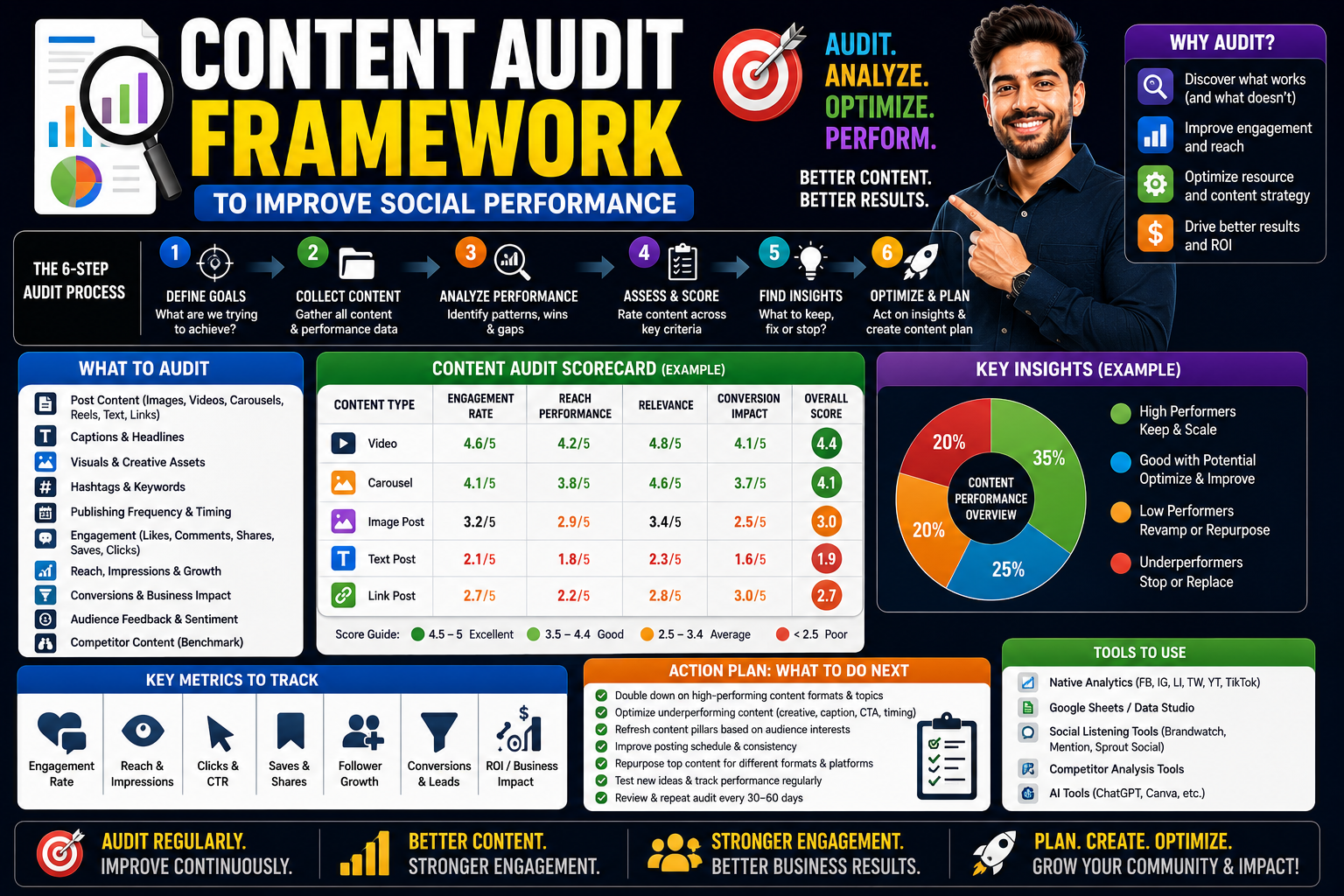
A content audit answers a question most teams avoid asking: which of the things we publish are worth the effort. Done once a quarter with a fixed method, it replaces opinion with a record you can act on.
Fix the window and the measures first
Choose a period long enough to include a normal spread of posts — a quarter usually works — and decide the measures before looking at any data. Deciding afterwards invites picking the numbers that support what you already believe.
Pair every volume measure with a quality one. Reach beside completion rate, or posts published beside response time, keeps the audit honest. Volume alone always rewards publishing more of whatever is cheapest to make.
Group before you judge
Sort posts by format and by topic, not by date. Individual posts vary enormously for reasons nobody controls; groups of ten or more start showing real differences. If a group has fewer than about ten posts, note it as unproven rather than as a finding.
- Format: short video, carousel, single image, text, link.
- Topic: the two or three themes you actually publish.
- Intent: educational, promotional, community, announcement.
- Effort: rough hours per piece, so you can see cost against return.
Read effort, not just outcome
The most useful column is usually the one teams skip: how long each piece took. A format that performs slightly worse but costs a third of the time is often the better format, and that only becomes visible when effort is recorded alongside results.
Watch for the piece that everyone remembers as a success. Single outliers distort judgement, and the fix is to look at the group median rather than the best result in it.
Separate the audit from the reaction
Collect and classify everything before forming a view. Reading results as you gather them biases the grouping — a piece that felt successful gets filed generously, and one that flopped gets explained away. Finish the sorting, then interpret.
Keep the raw sheet after the audit ends. Next quarter's comparison is only possible if this quarter's working is still available, and rebuilding it from memory produces a different answer.
Turn findings into decisions
Each finding should end in a decision with an owner: do more of this, stop that, test the other. An audit that produces observations but no decisions is a report nobody reads twice.
Limit yourself to three changes per cycle. More than that and you cannot attribute the next quarter's results to anything in particular.
Common questions
How often should a content audit run?
Quarterly for most teams. Monthly rarely accumulates enough posts to distinguish signal from noise.
What if the data is incomplete?
Audit what you have and note the gap. Waiting for perfect data is how audits stop happening.
Should underperforming content be deleted?
Rarely. Archiving or updating usually serves better, and deletion removes the evidence you would need next quarter.
Who should run it?
Someone close enough to the work to explain the numbers, and far enough from it to report an uncomfortable result.
Join the discussion
Share your question, feedback, or experience with this guide.
Login required
Please login to like this post or join the discussion.
No comments yet. Be the first to comment.