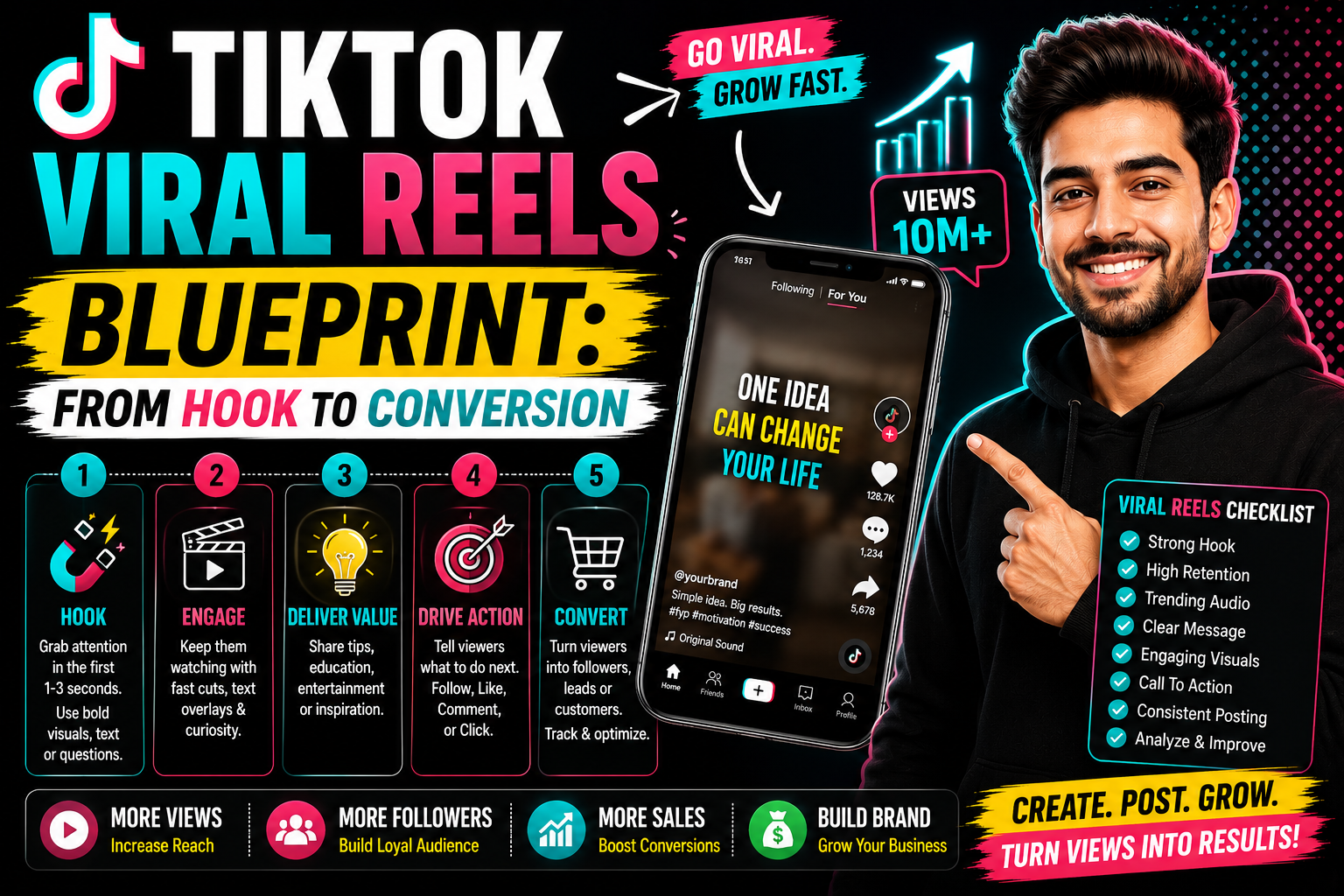
"Going viral" is not a plan, because the part that makes a video spread is the part you control least. What you can control is whether a video is watched to the end, and whether the people who watch it do anything afterwards. That is what this covers.
The first two seconds decide the rest
Short-form feeds are a series of decisions to keep watching. If the opening frame does not tell a viewer what they are about to get, they leave before the content starts. Show the subject immediately — the finished result, the problem, the surprising claim — and explain afterwards.
Avoid the slow introduction. "Hi everyone, in today's video" is a habit from platforms where the audience already chose you. Here they have not.
Structure for completion, not length
- State the payoff early, then deliver it.
- Cut anything that does not move the video forward.
- Keep one idea per video; a second idea halves attention on both.
- End on the point, not on a wind-down.
- Use captions — a large share of viewing happens without sound.
Completion rate is the measure worth optimising, because it is both within your control and closely tied to how widely a video is shown.
Make more of what worked, carefully
When a video performs, the useful question is which element carried it — the topic, the format, the opening, or the timing. Reproduce that element rather than the whole video. Teams that re-post near-copies of a hit usually see sharp decline, because the audience has already had it.
Keep a short record of what you tried and what happened. Without it, every month starts from memory, and memory over-weights the one video that did well.
Publish enough to learn something
Short-form performance is noisy. One video says almost nothing about a format, and a run of five can still be luck in either direction. Plan in batches of ten so the median tells you something, and treat anything below that as an impression rather than a finding.
Keep the production cost per video low enough that ten is realistic. A format that takes a day to produce cannot be tested properly, which is a reason to prefer simpler formats early.
Convert attention deliberately
Views without a next step are entertainment, not marketing. Decide before publishing what a viewer should do — follow for a series, read something, or try a tool — and make that one action obvious. Asking for three things gets none of them.
Be honest in the ask. Overstated claims travel further and convert worse, and they attract the audience least likely to stay.
Common questions
How long should a short video be?
As long as it stays interesting and no longer. Length matters less than whether people finish it.
Does posting time matter?
Less than the opening seconds. Test it after the content is working, not before.
Should trending audio be used?
Where it genuinely fits. Forcing a trend onto unrelated content reads as noise and usually underperforms.
How many videos before judging a format?
Around ten. Individual short videos vary far too much to read anything from one or two.
Join the discussion
Share your question, feedback, or experience with this guide.
Login required
Please login to like this post or join the discussion.
No comments yet. Be the first to comment.