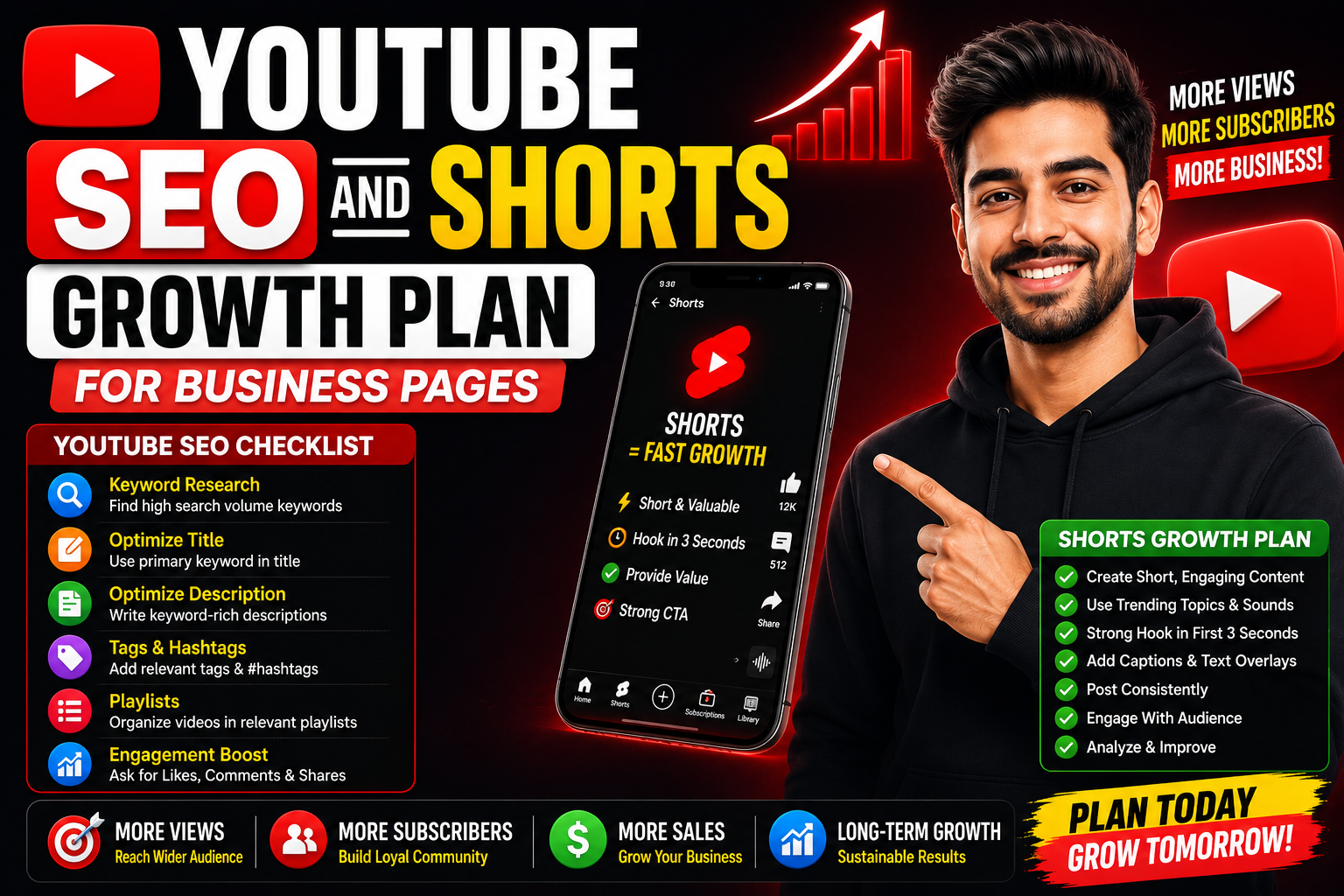
YouTube rewards two different behaviours, and most channels try to serve both with the same video. Search traffic wants a clear answer to a stated question. Browse and Shorts traffic wants something worth watching next. Planning them separately makes both work better.
Search: answer a question people actually ask
Search-led videos should match an existing question closely enough that the title reads like the query. Write the title before filming; if you cannot state the promise in a line, the video does not have one yet.
The description is for context and links, not keyword repetition. Two or three genuinely useful sentences plus timestamps serve viewers better than a wall of terms, and timestamps also help people find the part they came for.
Thumbnails and titles work as a pair
- Do not repeat the title text in the thumbnail; add to it.
- Keep the thumbnail readable at small size — test it at phone scale.
- One clear subject, not a collage.
- Avoid promising something the video does not deliver.
- Check how the pair looks beside competing results, not in isolation.
Overstated thumbnails do lift clicks and then lose retention, which is a poor trade on a platform that measures watch time.
Shorts serve discovery, not depth
Shorts are good at putting your channel in front of people who have never seen it and poor at explaining anything complicated. Use them to demonstrate a single idea and to point toward the longer piece that develops it.
Do not expect Shorts viewers to convert into long-form viewers at any particular rate. Some channels see a strong path, others almost none, and it depends on how closely the two formats cover the same subject.
Give the channel a shape
A channel that covers one recognisable area is easier to subscribe to than one that covers whatever came up that week. Viewers subscribe to an expectation, and an unclear expectation shows up as views without subscribers.
That does not mean never varying. It means a viewer should be able to say what the channel is about after two videos, and that the occasional departure reads as a departure rather than as the norm.
Read retention, then change one thing
The retention graph is the most useful screen in the analytics. A steep drop in the first thirty seconds is a promise problem — the title and opening did not match. A gradual slide is a pacing problem. A dip in the middle usually marks a section that could be cut.
Change one thing per batch of videos. Changing three at once leaves you unable to say which mattered.
Common questions
How many tags should a video have?
Few, and accurate. Tags are a minor signal; the title, thumbnail and first minute carry far more.
Should every long video get a Short?
Only where a self-contained idea exists. A clipped fragment without context performs poorly.
How often should a channel publish?
At a rate that holds during a busy month. Irregular publishing costs more than a slower steady schedule.
Do playlists matter?
They help viewers who want a sequence, and they help you see which subjects hold attention across several videos.
Join the discussion
Share your question, feedback, or experience with this guide.
Login required
Please login to like this post or join the discussion.
No comments yet. Be the first to comment.