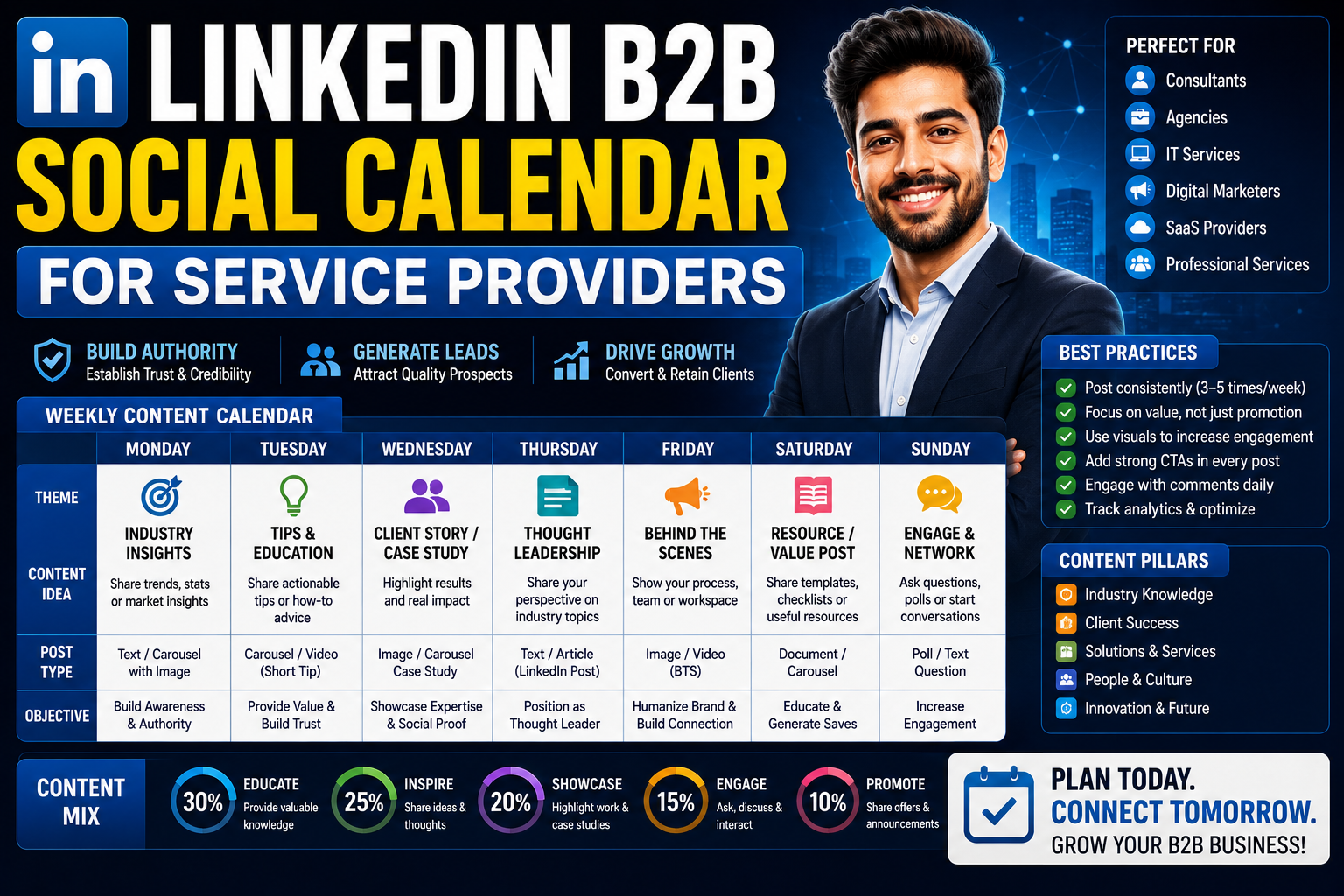
B2B posting fails more often from inconsistency than from weak ideas. A calendar solves a narrow but real problem: it removes the daily decision about what to publish, which is where most schedules quietly collapse.
Build around themes, not dates
Pick three or four themes you can speak to credibly and rotate them. Themes make planning fast because each slot already has a subject, and they make the account legible — readers learn what you cover and why they follow.
For service businesses the durable themes are usually the work itself: how you approach a problem, what a project actually involves, what clients get wrong before they call, and what changed in your field recently.
A cadence you can hold in a bad week
- Set frequency from a normal week, not your best one.
- Keep a standing list of ideas so no session starts blank.
- Batch writing — several posts in one sitting costs far less per post.
- Keep one slot flexible for anything timely.
- Reply to comments in the hour after posting, while the thread is live.
Two posts a week sustained for a year beats five a week for six weeks. The second pattern is more common and produces less.
Write for one reader
Address a specific person with a specific problem rather than an audience. Posts written for everyone read as written by nobody, and B2B audiences are small enough that being useful to fifty relevant people beats being bland to five thousand.
Lead with the point. Readers decide within a line or two whether to continue, and a slow build loses people who would have found the substance useful.
Repurpose deliberately
One substantial idea usually supports several posts: the argument itself, an example, a counter-argument, and what you would tell someone starting out. This is not recycling — each post stands alone and a reader who saw the first still gets something from the third.
Keep a note of which ideas have been used and when. Without it you will either repeat yourself within a month or avoid a strong topic because you cannot remember whether you covered it.
Measure what the calendar is for
The calendar exists to produce consistency, so measure that first: posts planned against posts published. Then look at saves, meaningful comments and profile visits, which indicate the content reached people it should. Follower count is context rather than a target.
Review quarterly. Drop the theme that consistently produces nothing to say — an empty theme is a scheduling problem, not a discipline problem.
Common questions
How far ahead should a calendar be planned?
Two to four weeks. Further ahead and it stops reflecting anything current.
Is daily posting necessary?
No. Consistency at a sustainable frequency matters more than volume.
Should posts be scheduled or published manually?
Schedule the planned ones; publish anything timely by hand so you can respond to what is happening.
What if a theme runs dry?
Replace it. Themes are a tool for making planning easy, not a commitment.
Join the discussion
Share your question, feedback, or experience with this guide.
Login required
Please login to like this post or join the discussion.
No comments yet. Be the first to comment.