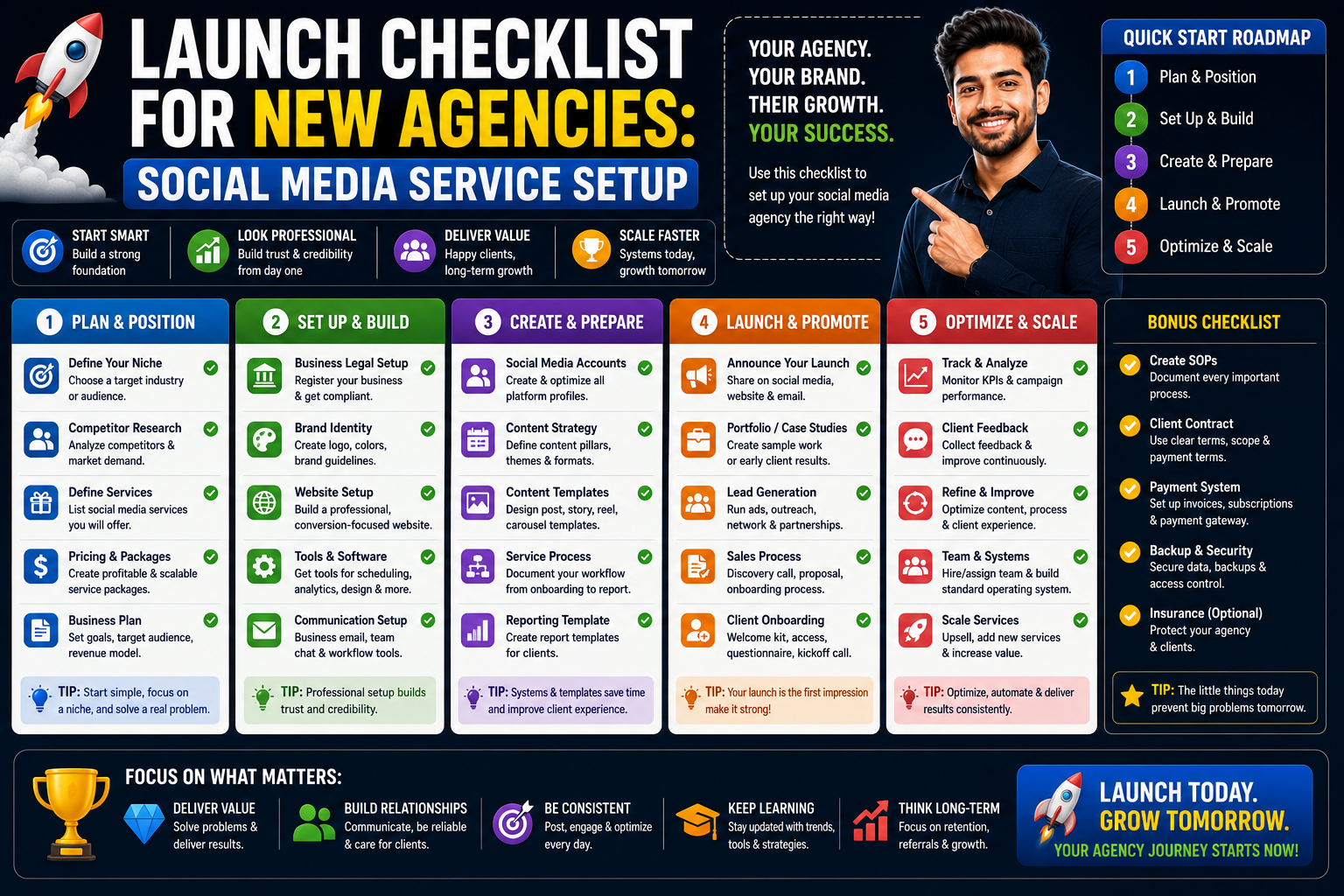
A new agency's first months are decided less by talent than by whether the basic machinery exists. This is the set of things worth having in place before the first client, because assembling them mid-delivery is what causes the early mistakes.
Define what you actually sell
Write down the service, what is included, what is not, and what a month of it looks like. Vague scope is the single most common cause of unprofitable early clients — not low prices. If you cannot describe a deliverable in one sentence, the client will describe it for you, generously.
Set a starting price you are willing to publish. It filters mismatched enquiries early and saves considerable time on both sides.
Access and separation
- Distinct access per client, never a shared login.
- Client-specific naming on every file and asset.
- One record per client: scope, contacts, approvals, payment terms.
- A confirmation step before publishing to any account.
- Documented cover arrangements, practised occasionally rather than theoretical.
Publishing one client's content to another's account is the error that damages a young agency most, and structural separation is what prevents it. Rapid account switching is when it happens, so a deliberate pause before publishing is the cheapest protection available.
The delivery rhythm
Fix a production cadence and protect it. Batch similar work — writing, filming, scheduling — because per-piece cost falls sharply and the schedule survives busy weeks. Keep one weekly slot for admin so it neither interrupts production nor gets deferred until it becomes urgent.
Agree approval timelines in writing. Most missed deadlines in agency work are approval delays, and they only become manageable once they are visible.
Money and admin
Agree payment terms in writing before the first deliverable, including what happens when an invoice is late. Send invoices on a fixed date rather than when you remember; irregular invoicing trains clients to pay irregularly.
Keep one place for every partnership and client record — scope, dates, usage rights, terms. Agreements settled in messages are almost impossible to find later, and payment disputes nearly always begin with nobody being able to locate what was agreed.
Track capacity per client
Aggregate capacity hides the account that is quietly over-serviced and the one being neglected. Record promised against delivered per client, and the imbalance shows up while it is still fixable rather than at renewal.
Common questions
How many clients can one person handle?
It depends on cadence and approval depth. Derive it from your own delivery record rather than a general figure.
Should rates be published?
A starting point, yes. It removes the enquiries that were never going to convert.
What should exist before the first client?
Scope document, access separation, a client record, and an approval process. Everything else can be built while delivering.
When should you hire?
When a repeatable, documented task consumes time you cannot recover. Editing and admin are usually first.
Join the discussion
Share your question, feedback, or experience with this guide.
Login required
Please login to like this post or join the discussion.
No comments yet. Be the first to comment.