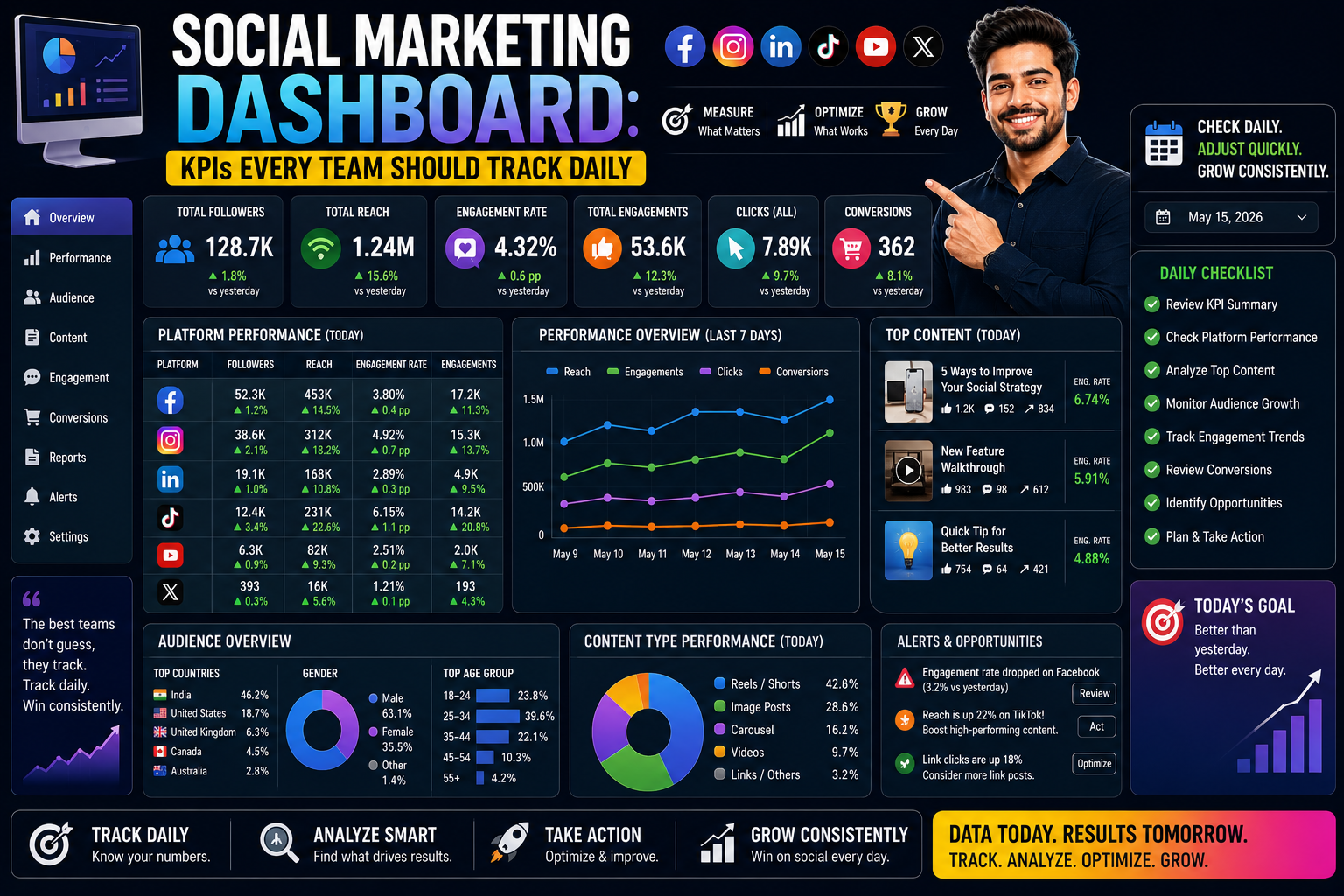
Most social dashboards fail the same way: they show everything that can be measured and nothing that changes a decision. A useful dashboard is short, and every number on it has an owner and a next action.
Start from the decision, not the metric
For each number ask what you would do differently if it moved. If there is no answer, the number belongs in an appendix, not on the dashboard. This one question removes most of what teams put on their first draft.
Prefer measures the team influences directly — output, response time, completion, delivery against plan. Reach and follower growth depend heavily on factors nobody on the team decides, so they inform but should not be targets.
A workable daily set
- Published against planned, for the current period.
- Response time on comments and messages.
- Completion or watch-through for video formats.
- Saves and shares, which signal usefulness better than likes.
- Click-through where a link is the point of the post.
- One quality measure beside every volume measure.
Five or six numbers can be held in mind and acted on. Fifteen become a reporting exercise, and the dashboard quietly stops being opened.
Separate the dashboard from the report
A dashboard is for the people doing the work and should answer "what needs attention today". A report is for people further away and should answer "what happened and what did we decide". Merging the two produces a document that serves neither, which is how dashboards end up with thirty numbers.
Define every metric in writing
Write the definition and the window next to each measure — what counts as a view, over how many days, from which source. Platforms define the same word differently, and undocumented definitions are why two people report different numbers for the same week.
Review the dashboard itself
Once a quarter, check which numbers actually drove a decision. Drop the ones that did not. Dashboards accumulate metrics the way desks accumulate paper, and nothing removes them unless someone is scheduled to.
A target consistently missed may be wrong rather than the team inadequate; one consistently exceeded may be too easy, or met in ways nobody intended. Both deserve examination rather than automatic renewal.
Common questions
How many metrics should a dashboard have?
Four to six. Beyond that they describe the work instead of guiding it.
Should follower count be on it?
As context, not as a target. Made a target, it pushes toward whatever inflates it fastest.
Daily or weekly review?
Weekly for most decisions. Daily numbers on social platforms are noisy enough to produce false alarms.
Should clients see the same dashboard?
Usually a shorter version, with the same definitions. Different definitions for the same metric is the fastest route to a difficult conversation.
Join the discussion
Share your question, feedback, or experience with this guide.
Login required
Please login to like this post or join the discussion.
No comments yet. Be the first to comment.